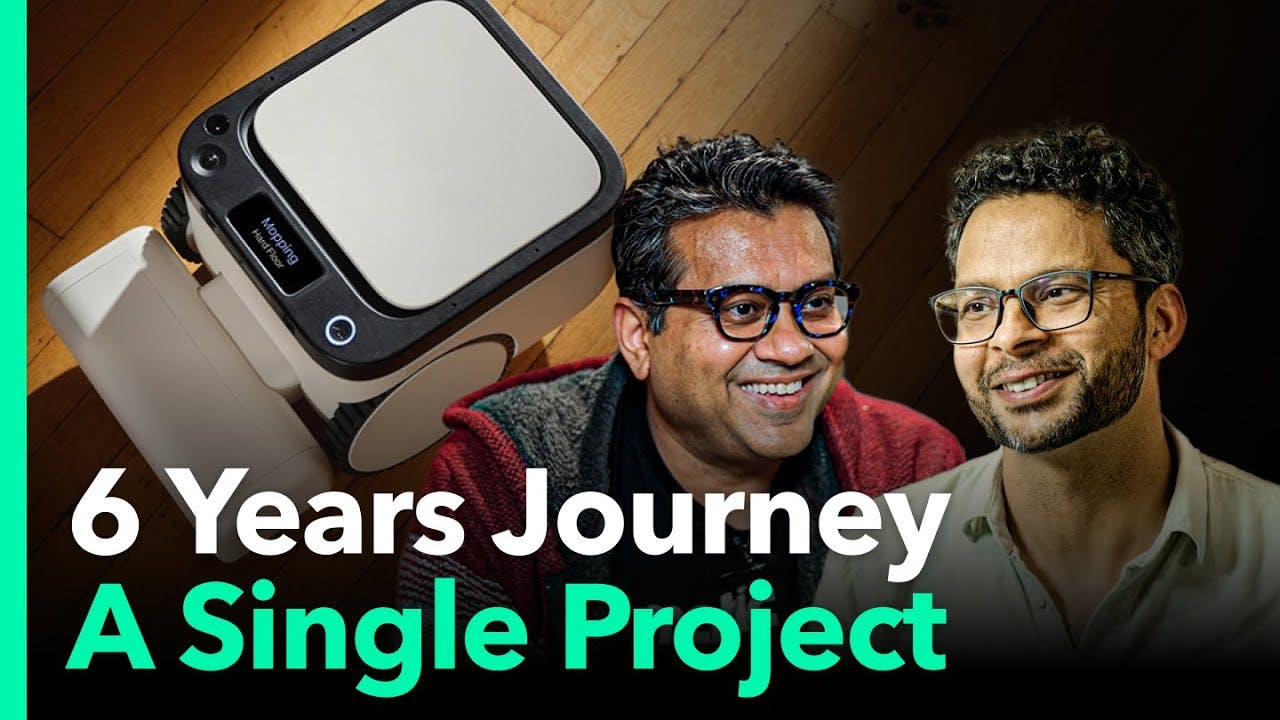
Key points
- Matic raised $30m from investors including John and Patrick Collison, Jack Dorsey and Matt Rogers after bootstrapping for six years with $1.5m.
- Mehul Nariyawala says four of the top five most valuable technology companies are hardware startups.
- Matic built over 200 prototypes, none production, betting vision and memory can make a floor-cleaning robot behave like a level-five indoor robot.
Matic's founders bet six years on a robot that sees
Matic is a bet that the floor-cleaning robot is a vision and memory problem. Today's machines have no memory and poor sight, so a robot with good suction can ruin a rug and repeat the same fifteen minutes after it is picked up. The founders left Google in 2017 and spent six years and their own $1.5m building a vision-first robot, betting that autonomy indoors is a two-decade problem.
Takeaways
- Hardware can build the most valuable companies. Mehul Nariyawala says four of the top five most valuable technology companies are hardware startups. Hardware takes years and is not for the weak-hearted, but building something amazing can produce something extremely valuable.
- Matic chose vision over many sensors. Every added sensor adds calibration work and failure points, so Matic absorbed that complexity into software instead. Its first proof of concept cleaned floors with cameras alone, the way Tesla does with cars.
- Cleaning robots have no memory of their work. Pick one up, dock it and restart it, and it repeats the same fifteen minutes. Matic wants a level-five indoor robot that spots dirt, tells rugs from hard floors and changes how it cleans, in a category growing 25% a year despite poor products.
- Matic spent six years on its own money. The founders put in about $1.5m and built more than 200 prototypes, none of which went into production. Matic has since raised $30m from John Collison, Patrick Collison, Matt Rogers, Jack Dorsey and Ravi Khan.
- Flutter was a technology looking for a problem. Gesture control hit number one on the Mac App Store in 73 countries, but Paul Graham kept saying it was a technology looking for a problem. They joined Nest to learn hardware and now want a product and a revenue model on day one.
- Founders should attack the riskiest part first. Navneet Dalal says hardware founders need patience and should ask why three times about how something is done. The real risk is market risk, since a business without profitability dies, and hardware only makes sense when software alone cannot solve the problem.
How the first robot came together
- Mehul Nariyawala bought a Dyson robot vacuum after getting a golden retriever. It had good suction and poor vision, got stuck on a rug and rubbed a patch away, a $1,000 device destroying a $2,000 rug he could not return.
- The first prototype used no 3D printers. They put an existing vacuum's motor in a hardwood shell with a cleaning head and a stereo camera that sent images over Wi-Fi to a laptop. Within three months they moved to a tall black robot and built two, called Batman and Robin, rebuilding the design from first principles.